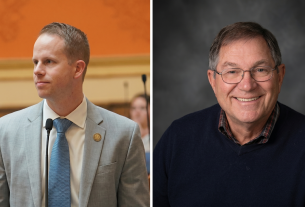
Utah House District 53 Race: The GOP Incumbent Against a Forward Party Challenge
Kay Christofferson didn’t face a primary this year. The 14-year incumbent and chair of the House Transportation Committee won the Republican convention unopposed within his own party. His real contest comes in November, when he faces Democrat Kevin Slater and John Boyd, a first-time candidate running under the Forward Party banner who says he knocked on all 10,000 doors in the district to get here. Christofferson and Boyd both sat down with utelection.info ahead of the race; here’s where they stand.

Kay Christofferson: A Transportation Expert
Background: State Representative since 2013, Chair of the House Transportation Committee, civil engineer with a career at Clyde Companies subsidiaries Geneva Rock and Sun Rock
Website: christofferson56.com
Christofferson is in his 14th year in the House. His background is in civil engineering and construction, built over a career with Geneva Rock and Sun Rock, both Clyde family companies.
Energy, Transmission, and the Long View
Christofferson describes himself as agnostic between energy sources: he wants an “all of the above” approach, abundant supply, and adequate transmission, arguing for a long-term view over short-term profit-taking. He was in Taiwan last week for a semiconductor conference (Taiwan covered his trip, he paid for his wife’s) and came away convinced newer chip generations will need less power and less cooling even as data center demand grows. He also pointed to legislation the Legislature passed to stop Rocky Mountain Power from charging Utah customers for wildfire damage in Oregon.
Corridors, Transit, and UTA’s Debt
His committee work centers on preserving road corridors before land develops around them, avoiding the need for eminent domain later. He’s pushed a north-south corridor in Eagle Mountain and is now looking at east-west options, since Pioneer Crossing and the Pony Express corridor won’t be enough on their own; he pointed to a North Lake route and a roughly $5 million study of a mid-lake route from Pelican Point to somewhere near Orem. On transit, he cited double-tracking and doubled frequency on FrontRunner between Provo and Ogden, though he said he hasn’t heard proposals to expand service hours. He noted UTA carries $2.4 billion in debt, and separately, that 85-90% of the cost of running transit service is covered by subsidy, with riders covering only 10-15% through fares.
Taxes and the Fine Print of Fair Treatment
He credits income tax revenue growth for recent increases in education funding, pointing to Utah’s back-to-back #1 rankings from U.S. News & World Report and Pew Research on economic outlook. He’s now pushing to eliminate the state tax on Social Security income, and acknowledged that both that effort and the Legislature’s recent income tax cuts more broadly have come from that same income tax surplus rather than from reduced spending. He said he tried and failed to pass a bill closing a loophole that requires a fired employee to give a written request before an employer owes a penalty for a late final paycheck, conceding businesses are treated better than employees under current law.
Federal Land and the Federalism Push
He sits on a federalism commission and argues the federal government’s ownership of 67% of Utah’s land could be managed better under multiple-use policy. Christofferson says Payment in Lieu of Taxes has shrunk year over year and is currently calculated at roughly a quarter of the value of the lowest-rated land class, grazing land. He wants more road access on federal land, both for multiple use and as firebreaks, and is working to keep historic RS2477 roads open.
Election Integrity and Burton’s Bills
Christofferson referenced a bill from Rep. Jefferson Burton, R-Salem, that he said would cost counties around $10 million; that matches Burton’s 2026 bill, HB479, whose fiscal note estimated $934,000 one-time and $10.1 million a year ongoing for counties. HB479 would have eliminated mail return of ballots for most voters, requiring a staffed drop box or in-person return instead unless a voter opted back in every eight years. It passed the House 42-30 along party lines, with Christofferson voting yes, before dying in a Senate committee.
Burton’s earlier bill, HB300 in 2025, created the opt-in system for staying on the mail ballot rolls in the first place; it passed 56-15 on a smaller fiscal note, about $4.9 million one-time and $4.3 million ongoing to counties, and Christofferson voted yes on that one too.
Prop 4 and Redistricting
Christofferson was broadly critical of how the redistricting fight played out, saying he supports repealing Proposition 4 and questioned Judge Gibson choosing the plaintiff’s map without being able to explain why she chose it. He said prop 4 was made by those who want to elect more democrats.
The fight traces back to the Legislature’s original 2021 congressional map, which split Salt Lake County across all four districts; the Utah Supreme Court ruled in 2024 that lawmakers could amend a voter-approved initiative like Prop 4 but couldn’t impair its purpose, and sent the case back to district court, where Gibson formally struck the map down in August 2025. She then gave the Legislature roughly 30 days to redraw it, a timeline Senate President Stuart Adams and Speaker Mike Schultz publicly called “arbitrary” and rushed compared to the nearly six months and 20-plus public meetings used to draw the original map.
The Legislature submitted one new map on October 6, and the plaintiffs submitted two, for three maps submitted total. Gibson rejected the Legislature’s map after finding partisan data was visible on the mapmaker’s screen while it was drawn, calling it “an extreme partisan outlier,” then chose from the plaintiffs’ two remaining maps, with the deadline from the Lieutenant Governor’s office only minutes away and no time left for another map to be drawn.
Data Centers
On MIDA and the state’s data center push, he defended the substance of the program but was critical of the communication around it, saying Senate leadership failed to explain it well. “It looked bad, but wasn’t evil,” he said.
What Keeps Him in It
Asked what inspires him, he pointed to the access the job gives him: helping constituents solve real problems, asking experts direct questions, and learning about new areas of policy.
Books Christofferson said he has recently read or is currently reading:
- Scriptures
- John Adams by David McCullough
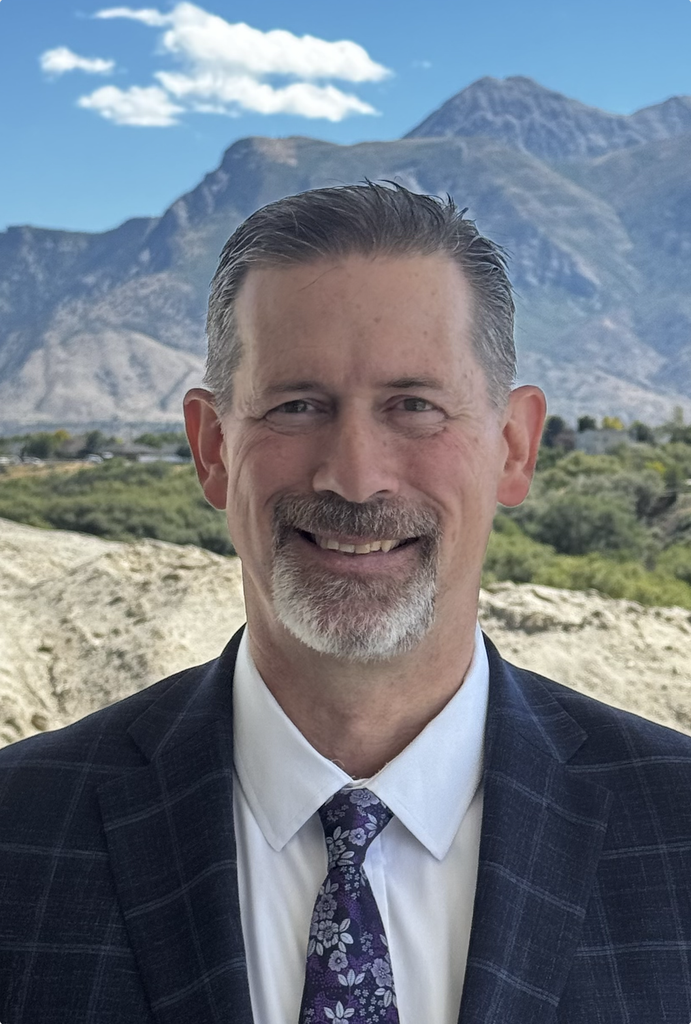
John Boyd: “Not Left. Not Right. Forward.”
Background: Marine Corps veteran (1990 Gulf War), startup entrepreneur/fractional startup exec (Claravine, Stat, J-Curve), Forward Party candidate
Website: johnboydforutah.com
Boyd was raised in Alaska in a blended family, then went to boot camp for the Marines and served during the 1990 Gulf War, stationed in Japan. After being married for only 5 days, he and his unit deployed to Japan in support of the war, and remained there for 9 months, as the war ended before his unit could rotate into the middle east. He later earned an MBA at the University of Utah and moved into startups in 1997. As co-founder, he still holds a stake in Claravine, a data standardization and governance company for marketing data, and in Stat, which builds operations and analytics tools for hospitals and clinics; his current focus is helping startups grow from $0 to $3 million. He’s lived in Lehi for 27 years, has been married 35 years, has 7 kids, and still has 2 teenagers at home.
He traces his decision to run to his reaction to national politics in 2025, citing the administration’s treatment of Ukraine and Canada as turning points that pushed him to engage more directly with state and federal officials. He started his journey by holding Ukrainian and Canadian flags on a Lehi bridge over I-15. Since then, he’s knocked on all 10,000 doors in his house district (53), has talked to 4,500 people during the campaign, and says the dominant theme he heard was that people don’t feel heard by their elected officials and are tired of partisan “chest beating” instead of problem-solving and doing what’s right for the community.
Election Integrity and Burton’s Bills
Boyd opposes both of Burton’s election bills: HB300 in 2025, which created an opt-in system for staying on the mail ballot rolls, and HB479 in 2026, which would have eliminated mail return of ballots for most voters and required a drop box or in-person return instead. He calls both parts of a pattern of disinformation about mail-in voting fraud trickling down from national politics. He cited a claim from Burton during committee presentation that 300 dead people voted, which Burton later walked back, and argues very few mail ballots have been found improperly registered.
Claims of widespread voter fraud, advanced most prominently by President Trump since 2020, have not been substantiated in court; dozens of post-election lawsuits alleging fraud were dismissed for lack of evidence, and federal election security officials called the 2020 election the most secure in the nation’s history.
Boyd backs Lieutenant Governor Deidre Henderson’s lawsuit against the current administration over an executive order he says lets a postal worker effectively decide whether ballots get delivered and wants state legislation protecting mail-in voting and shielding Utah’s elections from federal interference. He supports Proposition 4 and called the language in Amendment D misleading.
Immigration and Surveillance
He wants to protect due process and says Utah shouldn’t strip immigrants of legal benefits. Boyd raised concerns about Flock camera networks being used to build behavioral patterns on people rather than solve specific crimes, and said ICE has used the same tracking and facial recognition to intimidate protesters. He wants to propose legislation limiting where and how ICE can make arrests in Utah and cited his own work helping two Ukrainian immigrant families navigate the system.
AI, Transportation, and Local Planning
He said Utah shouldn’t be afraid of AI but needs to get ahead of regulation rather than react to damage after the fact, pointing to what he called a pattern of executive orders outrunning the courts. He wants legislation to mitigate risks from both AI and Flock surveillance before they get out of hand. On transportation, he described the drive to visit his father in Eagle Mountain, particularly around 2100 North, as a regular frustration, and wants more intentional, forward-looking city and county planning rather than default state override of local zoning.
What Keeps Him in It
Boyd wants legislators limited to two or three terms and says he doesn’t intend to stay in office for a decade or more. He’s raised roughly half his campaign funds himself and says he’s taken no special interest money. Asked what inspires him, he pointed to the resilience people show when facing hard problems, a theme he explored in a book he wrote, The Illustrated Guide to Smart Living.
Books Boyd said he has recently read or is currently reading:
- On Tyranny by Timothy Snyder
- 1776 by David McCullough